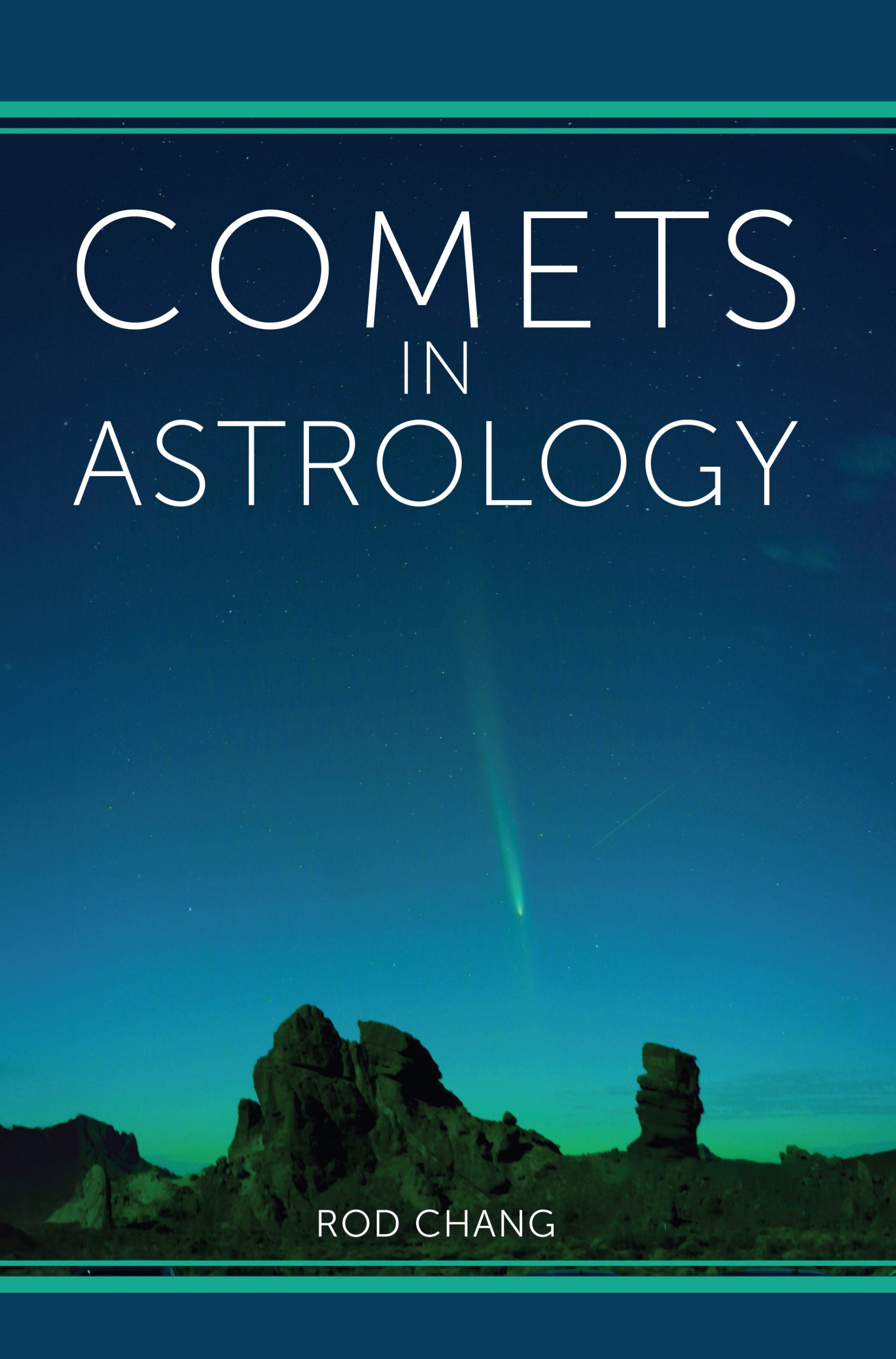
When the comet Panstarrs (C/2011 L4) appeared in the sky back in 2013, Rod Chang was approached by a reporter asking what astrological influence it would have. The question made him realise how little he knew about comets, and prompted him to start studying the phenomenon, in the process reawakening his relationship with the night sky and his love of astrophotography.
Now, after collecting more data and learning how to generate a comet ephemeris, the author has a clearer picture of their astrological meaning which he demonstrates in the form of many fascinating case studies. From a harmonious universe perspective, comets are seen as disruptors, irregular objects in the solar system, so this book is offered in the hope that it will encourage the reader to take more of an interest in the extraordinary celestial objects that have perplexed, fascinated and even frightened stargazers since time immemorial.

Rod Chang
Rod Chang has studied astrology for over twenty years, both through self-study and through the Faculty of Astrological Studies. His favourite aspects ...
Show moreComets in Astrology is a long-needed book. While comets have been observed since the dawn of time, literature on them is surprisingly scarce—especially from an astrological perspective. Rod Chang is changing this. He is a well-known astrologer of Taiwanese origin living in London. He serves on the board of the Astrological Association, runs two schools of his own, and is a familiar face on Instagram and YouTube. While this is his first book in English, he has a history as a TV astrologer in Taiwan and has published around twenty books on astrology in Chinese.
He is also a passionate astrophotographer, and I was lucky enough to see him working to capture the right shots of the Milky Way.
Although Comets in Astrology is easy to read, it begins by explaining what comets actually are from a scientific perspective: they originate in the Kuiper Belt (beyond Neptune) or even the more distant Oort Cloud. Because of their alien nature, comets were (and still are, for many) associated with something being introduced to our planet. Traditionally they were believed to be portents of large-scale negative events such as earthquakes, the death of a king, or outbreaks of disease. But they are also linked to important breakthroughs, innovations, or collective shifts. Comets carry an aura of superstition. Some people believed that simply seeing a comet could kill them, because of the chemical composition of its tail.
Chang begins his book with the approach of ancient astrologers: they noted the comet’s size, where it was first spotted, its color, brightness, and tail. Every detail was used to uncover the message the comet was thought to carry to our planet. And while we are now better at predicting when a comet will pass by and become visible, the astronomer Fred Whipple reminded us: “If you want to have a safe gamble, bet on a horse and not a comet.” In other words, comets remain unpredictable. They may become visible much later than expected, appear suddenly, or shine far less brightly than hoped for. They continue to surprise us.
Chang makes the excellent point that it is very difficult to pinpoint the appearance of a comet to a single moment, such as its first sighting. He therefore proposes using several moments to trace possible significations of this celestial messenger:
* the lunation before the comet’s discovery
* time of discovery
* first visibility
* closest approach to Earth (perihelion)
* the moment the comet crosses the ecliptic
He also urges readers to consider not only the tropical zodiac but also the constellations and planetary alignments. With these different times, we can track the comet’s path and note which signs it crosses. Each sign has its own set of significations. Water signs, for example, may point to the condition of water, fishing, navigation, tsunamis, and similar matters. Other signs bring different qualities and therefore point to different events.
Chang offers fifteen well-developed examples of comets and how they activate certain planets at different moments in his many charts. His first example relates to a comet of 1066, and the last one is from 2024. Each discussion includes event charts or nativities in which planets are touched by one or more of those five key moments. A particularly interesting example is Julian Assange, who had several planets triggered by comets at different points in his life.
This book offers a new perspective on comets but also cautions against treating them as just another “point” in the horoscope, to be read as though they were a planet—which they certainly are not. A comet is a temporary alien visitor to our world, carrying messages and gifts that we must decipher.
This book is an excellent starting point.
Tania Daniels for The APAI Chronycle
With Comets in Astrology, Rod Chang introduces us to a topic that I suspect many of us in astrological practice have never considered. He eases us into this new material with an introduction to the astronomy, basic composition, history, and mythology of comets, providing useful background before considering detailed case studies.
Perhaps it is the novelty of the subject that makes this book so interesting, but I would be remiss not to mention that Chang has a way of presenting the material in a way that is easy to understand and absorb. If you thought (or think), ‘a comet, is a comet, is a comet’…as it turns out, not so much!
The book is professionally researched, rife with detail and fascinating examples. Reading the first few chapters I found myself wondering what modern day examples Chang would include. The statement, ‘it is not surprising people associate comets with human and natural cataclysms,’ had me wondering what recent or imminent comet sightings would relate to the current world climate?
The potential influence of comets on an individual’s chart is illustrated using examples of Steve Jobs, Julian Assange, and Agatha Christie. Each account is detailed, reflecting ‘moments in a comet’s journey’ which are connected to events within the individual’s life. The ‘Comet Case Studies’ in the subsequent chapter, provide a broad selection of individual, mundane and historic examples, all well worth taking the time to digest.
I find it strangely encouraging that Chang has noted, and underscored, the characteristic ‘unpredictability’ of comets. As humans, we often fall into a ‘rut’ of predictability. Comfortable patterns such as cookbook definitions, what we are led to believe, the need for continuity or certainty, relying on what we ‘know’ versus what we might learn, all leading us to operate with a limited view. Perhaps within the practice of astrology, the unpredictable nature of comets will encourage us to open ourselves up to a broader range of meaningful possibilities.
I found the author’s excitement and desire to share what he has learned quite heartening. Comets in Astrology offers a starting point from which we might consider comets as a means to highlight or emphasize notable characteristics or events, expanding our usual astrological viewpoints. After reading this book I would like to think many will consider Chang’s perspective, that we ‘can view comets as signs to leave the past behind and create a new future.’ What unpredictable adventures lay ahead?
Jayne Logan www.astrobookclub.com
That astrologers in the past had something of significance to say about comets is evident in Shakespeare’s play Julius Caesar. Calpurnia, Caesar’s wife, says: ‘When beggars die, there are no comets seen; The heavens themselves blaze forth the death of princes.’ (Act 2, Scene 2). Theatre goers would have understood the implication of such cosmic phenomena.
This fascinating new book by Rod Chang endeavours to revitalise the use of comets in astrology. In the past interpretation was by colour and shape but Rod warns against the use of colour interpretation these days because photography tends to calibrate objects green, or so they appear to human eyes. Though the basic shape is a nucleus and a tail – the tail always facing away from the Sun – slight variations do occur. If the comet looked like a trumpet for instance, it might presage war. Interpretations generally however, can be helped by studying mythology suggests Rod.
Since comets do not move along the ecliptic in an orderly fashion, and instead have an irregular orbit, some causality or correspondence happening in the world tends to be irregular too. It is generally agreed however, that great things happen when a comet is sighted, subsequent to which society gives a leap forward in consciousness, awareness and circumstance. As every school child knows, the comet of 1066 put an end to the Anglo Saxon line due to the famous Battle of Hastings when King Harold Godwinson was killed by an unfortunate arrow shot in the eye. The decisive battle ushered in the Franco-Norman line after William the Conqueror’s victory against the reigning king. A comet appeared just before the Suez Crisis in 1956 when Egypt annexed the Suez Canal and Israel, France and England invaded. This heralded the change in leadership in England and altered the status quo in the Middle East.
Particularly helpful to the astrologer is the list of the various stages in a comet’s trajectory regarding time to show how it may impact a chart. Here are the first two of those stages which are particularly sensitive in Rod’s experience: (a) when the comet is first discovered and (b) the time the comet becomes visible to the naked eye. There are several more. Rod suggests that 12 months either side of these various occurrences, as being the time operative for any event. A comet appearing near someone’s birth is of course of great importance, and is likely to presage events occurring subsequently when another comet appears later on in that life.
Rod gives many examples of natal charts both current and historic. The mixture of familiar names such as Elon Musk and Boris Johnson as well as those of the past Agatha Christie and Mark Twain will help the Reader to understand comets further. Fascinating charts linked to Mundane Astrology include Comet Ikeya-Seki in 1965 which coincided with the Uranus/Pluto conjunction in Virgo opposed by Saturn and Chiron in Pisces, which Rod says, brought with it immense cultural shifts in society worldwide. The correlation of planetary movement at the time of a comet’s appearance will naturally impact on interpretation.
Of recent times, actually in 1995, the Comet Hale-Bopp (C/1995 O1) seemed to have heralded several world events: some were tragic but others like the introduction of the Harry Potter books delighted the young and the young at heart. This was on 26 June 1997 when this comet crossed the celestial equator. As mentioned, what else is happening in the sky is likely to influence the outcome.
What would interest astrologers most of course is to locate comets in their charts and this is clearly explained in one very illuminating chapter. A step by step narrative and visual guide gives the Reader a thorough tutorial. What is helpful too is the chapter on Comets through the Elements.
Clarity as well as depth is pronounced throughout the book, which is naturally informative, and a pleasure to read.
Wanda Sellar for The Astrology Quarterly
“Expect to be captivated and enthralled. Rod Chang writes clearly and might soon be known as a ‘Master Cometeer”
Christeen Skinner – from the Foreword