
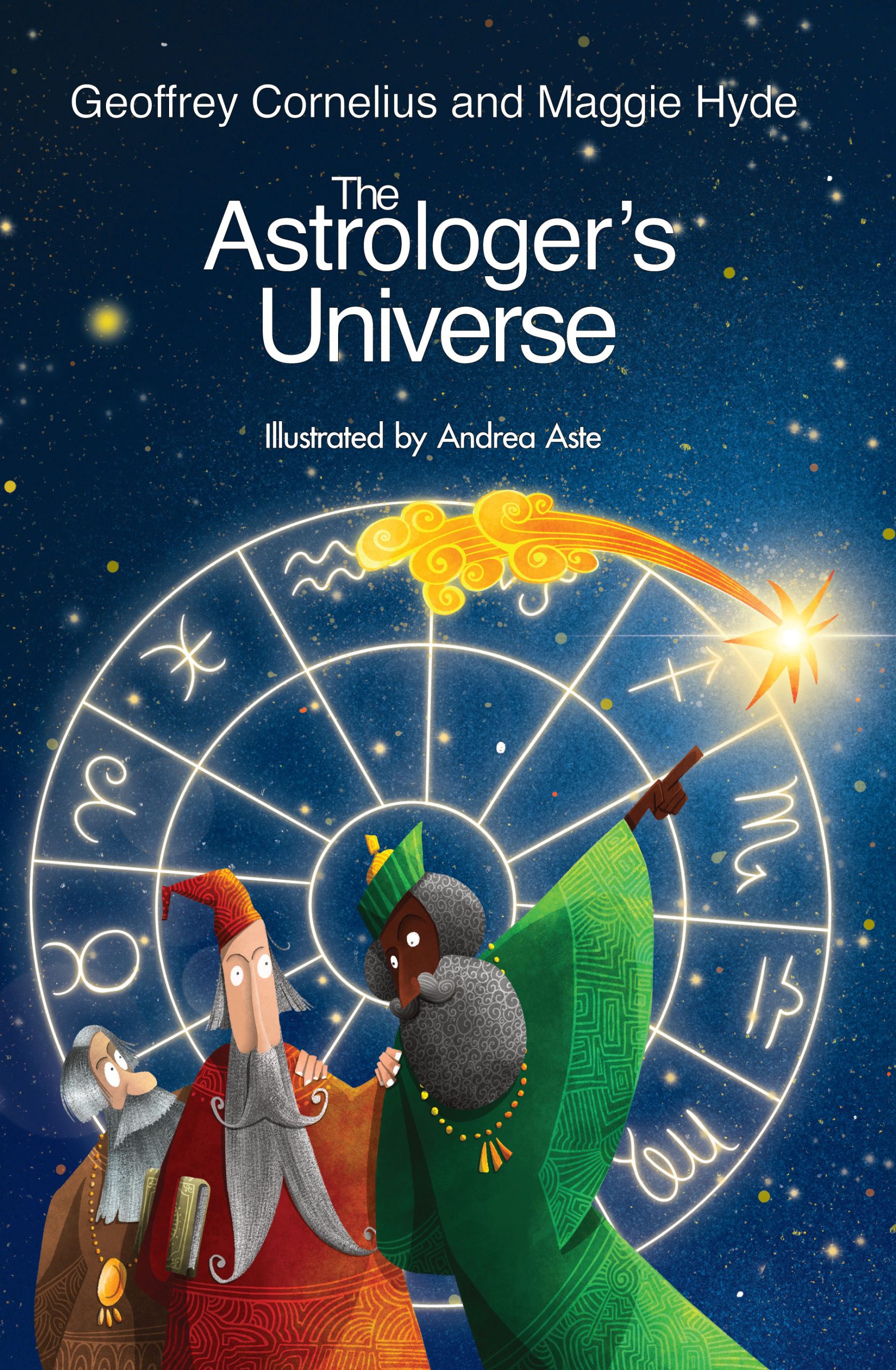

“The illustrations really are wonderful…Andrea is clearly very talented. So refreshing to have a unique layout…honestly, it was a real joy from beginning to end. I felt uplifted after finishing it.” Jayne Logan www.astrobookclub.com
“The Astrologer’s Universe is a must-have for beginners. For anyone who is floundering in the foothills of astrology this short book will be a blessing.” Marjorie Orr
The Astrologer’s Universe is the revised and updated version of Astrology for Beginners, originally published in 1995. Stunningly illustrated courtesy of Andrea Aste, it is the ultimate time traveller’s guide through the world of astrology. From the eclipse calculations at Stonehenge to the astrological relevance of the iconic Steve Jobs, the historical context of astrology, its characters and its battles form the perfect backdrop to any astrology course, but will also entrance the casual reader.
Details on the signs, planets and elements are also covered as are the basic techniques of horary, synastry, business and psychological astrology, and transits, progressions. It’s a small book with a huge heart, just waiting to join your bookshelf.
If you fancy a sneak peek, watch this reel on our Youtube channel 😀

. Geoffrey Cornelius and Maggie Hyde
GEOFFREY CORNELIUS was a consultant astrologer with a background in divination and philosophy. Throughout his life, he taught and practised div...
Show moreTo study astrology is to undertake a wondrous journey. We all start this journey by wondering about our own Sun sign, and it’s a rare astrology enthusiast who doesn’t have a copy of Linda Goodman’s Sun Signs on their shelves. Published back in 1968, it was the first astrology book ever to hit the New York Times Best Seller list. It swung the door open into a world where astrology suddenly made a lot of sense to a lot of people.
Linda Goodman is rightly credited with bringing astrology back into the mainstream, rather than leaving it to lurk in the corners of occult bookshops. Media astrology took off and was huge throughout the 80s and 90s, but the market really exploded with the advent of the internet.
Astrology is now everywhere. The posting on websites, forums and social media is literally at saturation point, there’s some quality content from experienced astrologers and some rising stars but, let’s face it, most of it is junk. I seriously wonder how the new student can possibly know where to start, or what to believe.
It’s vital to place The Astrologer’s Universe in this context because to say that this book is a “must have” is not a comment I make lightly. Authors Geoffrey Cornelius and Maggie Hyde both have an impressive history of “hands on” astrology, encompassing consultations, authorship, teaching and lecturing home and abroad, from beginners right through to university level qualifications, yet this is no “cookbook” and neither is it just academia. It’s an extraordinary encapsulation of both history and craft.
As they glide through the complexity of the origins of astrology, rooting each individual firmly in both tradition and spiritual purpose, they lead the reader seamlessly into astrological practice. All the tools for horoscope interpretation are here, with succinct examples and delightful illustrations.
Prepare for some lightbulb moments. Learning how to zoom in on what the astrology is telling us, discovering where it came from and how it really works, is the biggest gift of this absorbing book. No more lost at sea. The Astrologer’s Universe is a beacon of both pragmatic and creative craft, pulling us back onto dry land whilst keeping us connected to the heavens above.
This is a book you will want to read again and again, and dip into again and again. It’s the ultimate reference book and part of Geoffrey Cornelius’ legacy. In life Geoffrey had a way of being able to reach every single person in his audience, sharing his expertise and endless knowledge of his craft whilst always being in respectful awe of the magical nature of his material. This is what he communicated to his students, and is what he and Maggie Hyde now communicate to their readers. The Astrologer’s Universe reminds us to honour tradition, to learn our craft, and to respect that astrology always links us up with something bigger than ourselves.
Joanna Watters www.joannawatters.com
What can I say about ‘The Astrologer’s Universe’? I suspect the same as any astrologer reading this work… welcome to my world! What a lovely surprise! I wish I had access to such a resource when I first began my studies. Geoffrey Cornelius and Maggie Hyde have given us so much detail, perspective, and value within a relatively small volume. They have drawn together all the key foundational elements essential in developing sound astrological understanding, in a straight-forward, easy to understand, practical guide. Beautifully written and illustrated (Truly, I loved the illustrations!), the book is presented concisely and with clarity.
One of the things I love about exploring new books, regardless of the level, is that I invariably learn something new or consider a fresh perspective on an old topic. Initially, I thought the title of this one might be a bit grandiose, but it quickly became clear that within these pages is everything that the astrology student needs to know, and consider, as they embark upon their astrological journey. For example, what kind of astrologer you want to be might be an essential consideration in the initial stages of one’s education in this vast and complex field. Similarly, other topics included in ‘The Modern Debate’ (PART V), provide insight into standard objections from those who may be ill-informed or suspicious of the subject. This type of background offers ‘food for thought’ and, equipped with the facts, might give the novice an indication of what to expect along the way.
Well-structured and practically divided into five parts, we are provided with background on the history of astrology, the symbolism, how to interpret a horoscope, an introduction on types of astrology and various avenues of application. The history, while condensed, is packed with useful background from the Egyptians to Alan Leo. “The Astrology Primer” (PART II) offers the keys to the basic vocabulary of astrological language in a complete, concise, and uncluttered format that can be used as a resource to support one’s learning. In PART III, a practical step-by-step structure for horoscope analysis which draws together all the key pieces for interpretation and, with the examples provided, it could not be any clearer.
When it comes to learning I am a huge fan of practical tools. In this case, Cornelius and Hyde have really knocked it out of the park! ‘The Astrologer’s Universe’ was a joy to read. It is a resource I will recommend to anyone starting out in this field. And, it is well worth a read for any practicing astrologer, if only to freshen our perspective.
Jayne Logan www.astrobookclub.com
“It is a plain fact that astrology is a pack of lies in a literal sense … each and every horoscope … is an attack on the probity of science.”
On the frontispiece of an invaluable primer about astrology by Geoffrey Cornelius and Maggie Hyde are listed the lame and sometimes mendacious brickbats thrown at the ancient art which are systemically picked apart in the pages following.
A revised and updated version of the 1995 Astrology for Beginners with inspired and illuminating new illustrations, The Astrologers Universe is a must-have for beginners. The history is laid out from Stonehenge 3000 BC onwards – how did they calculate the 18.6 year eclipse cycles? – and on through the Egyptians and astronomically aligned pyramids, through Mesopotamia, Greece, Rome, into mediaeval times and on. Informative and handy as ammunition in arguments with nay-sayers.
Thereafter working with astrology is laid out lucidly in simple terms with planets, elements (Cardinal, Fixed, Mutable), modes (Fire, Earth, Air, Water) and aspects; with each planet and sign explained with key words. The major configurations are graphically illustrated and made understandable.
Thence onto the tricky synthesis when the separate parts of the jigsaw have to be pulled together into a broad pattern. The authors start with a thumbnail sketch of key words for the Sun (= essence), Moon (= habit and response) and Ascendant (= appearance and identity). The example given of Margaret Thatcher is to the point – a reactive Libra Sun, tenacious and vengeful Scorpio Ascendant, and a showy Leo Moon.
Then checking down a list of elements, planets on an angle, major aspects and configurations etc. For beginners it lays out a step by step process through the maze and morass of the 2500 pieces of information contained in a birth chart. It is daunting at the start of the learning process to manage the complexities of assigning priorities and getting to grips with the overall pattern – so this will provide clarity and clear away a good deal of the fog of panic.
There are other concise outlines covering horary, financial, world affairs and relocation astrology.
For anyone who is floundering in the foothills of astrology this short book will be a blessing.
Marjorie Orr
Although best-known for his thought-provoking book on the philosophy of astrology (especially as it is used in live consultation sessions) ‘The Moment of Astrology’, the late Geoffrey Cornelius also contributed to a few simpler books, one of which was ‘Astrology for Beginners’, which he co-authored with his long-time partner and astrological collaborator Maggie Hyde. As the title suggested, the original Icon Books edition of 1995 was designed as an introduction to astrology and its principles for complete beginners. It was profusely illustrated by an artist called Chris Webster with jocular comic-strip-styled sketches.
31 years later, the book has been relaunched by The Wessex Astrologer under a new title, ‘The Astrologer’s Universe’. The text itself has been selectively revised, updated, and corrected. Perhaps the most striking difference in this new edition, however, is the wholesale replacement of all the original cartoonish artwork with a completely new set of illustrations by a different artist, Andrea Aste, whose style is less comic-strip, more surrealism with excellent fine line work and detail. I get the feeling that he could be at home illustrating fairy tales. The result, in any case, is less in-your-face, less jokey, and subjectively somewhat more refined and graceful, than Webster’s art in the original edition – which is not to say it wasn’t good of its kind, or what the authors wanted at the time!
The text of the book remains very much a taster of astrology from multiple angles, including an introduction to the elements astrologers work with and bits and pieces of potted history touching on how astrology has developed in the light of both ancient and modern thought. A comprehensive history lesson it isn’t, but it is meant to whet the appetite of the idly curious who want to know a bit more of what this astrology lark is all about, without necessarily committing to believing in any of it or otherwise buying into its doctrine. However, some of those readers will find the content resonates with them enough to motivate them to take the next step of either buying a comprehensive learning book on astrology or attending a class or course. As such, ‘The Astrologer’s Universe’ could make for a thoughtful present for your average sceptical friend or relative, with unpredictable results. You just never know who will be motivated to study astrology after reading this book!
Philip Graves

